

Many healing professionals and practitioners from other cranial approaches often ask me about the difference between the Integrative Cranio Method I teach and practice and Craniosacral Therapy.
In this article, I explain the key differences between the two methods.
FINDING THE KEY LESION
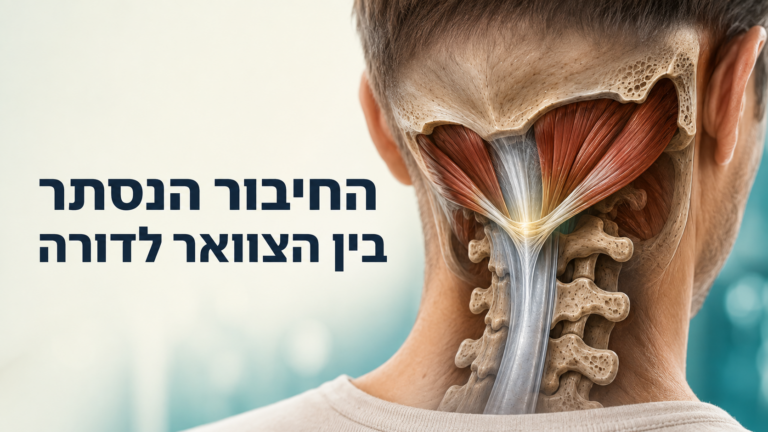
In the Integrative Cranio Method, I use the cranial mechanism (through the dura and its connections to the fascial system) as a medium to find the key lesion (dysfunction) – the root cause of the problem at any level. The source can be in any system of the body: mechanical, visceral or cranial.
Over many years I developed a systematic diagnostic method to identify the hidden root of the problem. For example, I conduct the initial cranial diagnosis and then, according to my findings, when I treat the source of the dysfunction, all cranial dysfunctions should be solved if the source has been identified correctly.
VERIFYING SUCCESS OF TREATMENT
Specific tests are applied before and after treatments to verify the body's response to the technique – using the cranium as an indicator. I see the cranial system as the core system of the body. Therefore, when a change is applied to the cranial system, a response will be immediately exhibited in the body – specifically through the fascial system.
Using the Integrative Cranio Method, a practitioner can diagnose dysfunction in any part of the body – whether the liver or the knee. And since the key lesion is being treated – not just the symptoms – a change will be immediately apparent.
In this way, the practitioner always knows whether they are on the right track and if their initial assumption about the cause of the problem was correct. Once the source (key lesion) is found with the use of the Integrative Cranio Method, potentially any dysfunction can be treated.
CRANIAL-VISCERAL-SKELETAL CHAINS
I developed cranial-visceral-skeletal chains in the Integrative Cranio Method as a means to distinguish which link in the chain is the key. If the right link is treated, the other parts of the chain will release, improving the patient's condition immediately.
For example, one of the chains I often teach in my Integrative Cranio courses is Dura Tension-C3-Diaphragm-Psoas. The dura is attached to the C3, the C3 innervates the diaphragm, the psoas attaches to the diaphragm and the kidney is attached to the psoas. Any link in this chain can affect the cranium and vice versa. Any of these tissues can interfere with the function of the other tissues.
This chain is very common because the psoas is involved in most cases of lower back dysfunction. However, there are a number of different reasons for lower back pain. If this chain is balanced, a change in the tissue will be apparent and sometimes so will the range of movement or the intensity of the pain. The other chains I use in the Integrative Cranio method will be discussed in future articles.
INCORPORATION OF VISCERAL, MECHANICAL & FASCIAL TECHNIQUES
Because of the development of these chains and the perspective that the cranial system is influenced by other systems, I incorporate teachings from the visceral, mechanical and fascial approaches in order to address all aspects of the chains, with the end result being the release of the cranial system.
INTEGRATION OF OSTEOPATHIC THEORIES INTO CRANIAL TREATMENT
In the Integrative Cranio Method, we incorporate osteopathic theories that relate to or affect the cranial system for diagnoses and treatment.
I use a lot of the Chapman reflex points to verify the effect on the inner organs. For example, the hyoid bone is critical to the cranial system. In balancing the hyoid bone I want to see if the thyroid is affected. I check the Chapman reflex point for the thyroid and then I treat the hyoid. If the hyoid is released, most of the time the Chapman reflex will disappear. This is how I know I have influenced the thyroid and balanced the hyoid.
We also incorporate Littlejohn theories (spinal mechanics), central tendon theory and bow-string theory. All of these theories help us to understand the unity of the body and its connection to the cranial system.
FIVE PRECISE TOUCH DIAGNOSES
I use five different methods of touch to diagnose the five layers in the cranial system and to recognise which one of these five layers is the key dysfunction. The five-touch technique offers a very precise diagnosis. In each layer, there are certain specific connections to the rest of the body. I decide on which level the cranial dysfunction exists. I check the connection of this dysfunction to the rest of the body.
For example, the dura level is connected to the fascia system, scar tissue and visceral dysfunction. If you have scar tissue, the tissue will pull the fascia and potentially affect the cranium. A test must be conducted to find whether this is the case. If it is, you must learn how to treat it. We learn how to treat scar tissue in my Integrative Cranio courses because it is a very common issue.
INNOVATIVE CRANIAL TECHNIQUES
The Integrative Cranio Method teaches original and innovative diagnostic and treatment techniques – developed during my many years of practice – to specifically diagnose and treat the cranial mechanism. These techniques cannot be studied elsewhere. They enable the practitioner to choose the most effective technique from the vast number that exist.
For example, when diagnosing the coronal suture, I want to know if the tension in the suture is coming from compensation of other places, or whether the problem is in the suture itself.
To determine this, I can induce a flexion movement in the frontal bone and see if the parietal bone is also moving into flexion.
Then I do the same for the parietal bone.
If there is no movement in the parietal bone while moving the frontal bone, but there is movement in the frontal bone while moving the parietal bone, I know the force from the frontal bone doesn’t affect the parietal bone.
I can then search for places that might be blocking the frontal bone, such as the frontonasal suture, falx cerebri or frontosphenoidal suture.
When I release the correct suture, movement will be restored in the frontal bone, and thus the coronal suture will be released. Only if the movement is blocked in two directions – from frontal to parietal, or from parietal to frontal – do I work directly on the suture.
In summary, the Integrative Cranio Method is a full-body healing approach which uses the cranial mechanism as the central axis of diagnosis to find the root cause of the patient’s problem. It works on all systems of the body – muscular-skeletal, neural, circulatory and endocrine – and it incorporates fascial, visceral and mechanical techniques to heal all levels of the being.